# Websites Und Digitale Systeme.Html
**Source:** https://en.goeke.digital/insights/websites-und-digitale-systeme.html
**Language:** English
---
Topic area
# Websites and digital systems
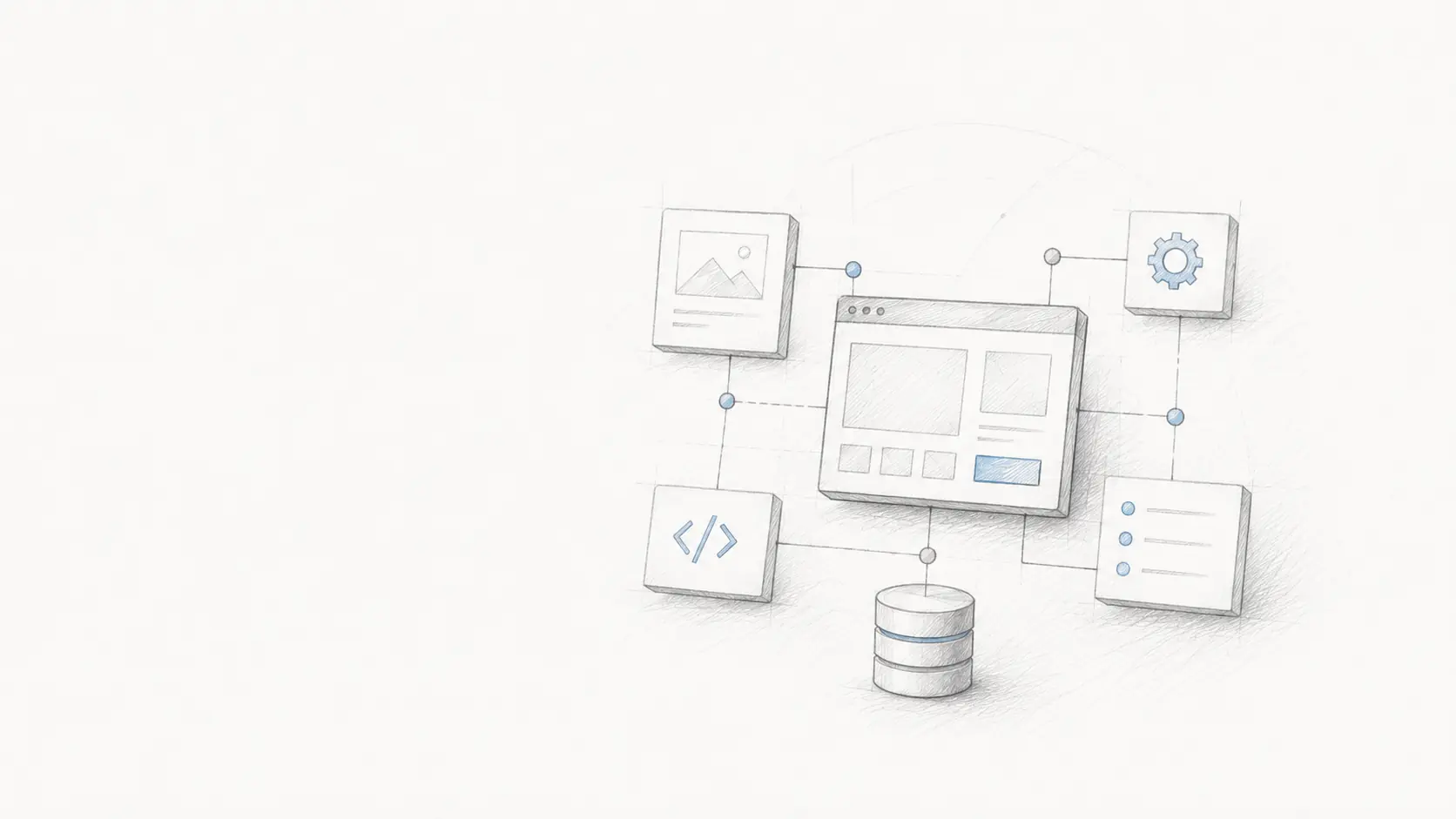
How websites connect positioning, content, user guidance, data, and processes into a manageable infrastructure.
Reading path
## Introduction to this topic
### Strategic basic function of the website
1. The company website as a system of trust and sales
The core contribution defines the website as a connection of orientation, trust, qualification, decision, and process handover.
### Real decision paths
2. Customer decisions rarely follow a straight funnel
The contribution shows why website architecture must support multiple entry points, deeper dives, and jumps back.
### Technical manageability
3. How companies avoid unnecessary dependencies on tools
The practice analysis categorizes data sovereignty, interoperability, documentation, and exit capability.
### Mediated Information Usage
4. Digital assistants are changing access to the company website
The historical perspective reconstructs the situation in October 2024, when search and assistance systems increasingly mediated content directly and performed initial surface actions.
### Machine-readable expertise
5. Website architecture as the basis for machine-readable expertise
The contribution connects page roles, hierarchies, entities, authors, sources, and internal links to an interpretable knowledge architecture.
### Current system requirement
6. Websites for people, search engines, and digital agents
The second core contribution, as of May 2026, organizes the common architecture for human use, machine accessibility, and controlled agentic action.
## The website is part of a digital infrastructure
The topic area 'Websites and digital systems' deals with the corporate website as a connecting system level. It is the place where a company organizes professional meaning, answers user questions, makes trust understandable, supports decisions, and hands over actions to internal processes.
This role extends beyond design and technical development. A website can be visually high-quality, fast, and functional, yet still generate little business orientation. Conversely, well-founded content can lose its impact if it is in an unclear page structure, not linked, or does not lead to a comprehensible next step.
The central question is therefore not: How modern is the website? It is: How well does it connect meaning, orientation, decision-making, and technical connectivity?
## Central business problems
### The website describes, but does not guide
Many corporate websites contain a complete overview of services. Nevertheless, interested parties do not quickly understand which service fits their situation, how the process differs, and which next step is sensible.
The problem is rarely just in the text. It arises from the connection of positioning, page roles, navigation, evidence, and contact channels.
### User journeys are planned too linearly
An ideal user journey can help with planning. However, real B2B decisions often follow multiple loops. Stakeholders research, compare, coordinate, check evidence, and return to previous questions.
A website therefore needs clear main paths and, at the same time, meaningful returns, deeper dives, and alternative entry points.
### Tools form a system without shared responsibility
Websites, CRMs, newsletters, analytics, appointment booking, and automation are often selected individually. The solutions work, but data flows, access, documentation, and responsibilities remain inconsistent.
This creates a technical landscape that is convenient in everyday use but difficult to manage during changes or failures.
### Expert knowledge remains fragmented in individual pages
Good content does not automatically create an understandable knowledge architecture. Search systems and other machine users require recognizable relationships between organization, authors, services, topics, sources, and evidence.
If these connections are missing, expertise remains digitally available but only partially interpretable.
### Agentic use expands the risk surface
Digital agents can not only read, but in limited cases also act. They can fill out forms, transfer information, or trigger website functions.
This creates a new responsibility. Technical accessibility alone is not enough. Authorization, consent, confirmation, error handling, and logging must be explicitly planned.
## Most important terms
### Website Architecture
Website architecture connects page roles, hierarchies, navigation, internal links, functions, and interfaces. It organizes not only content but also interactions and technical handovers.
### Information Architecture
Information architecture structures terms, categories, topics, and access paths. It helps people and technical systems to find content and understand relationships.
### Decision path
A decision path describes research, understanding, proof of evidence, coordination, and action, including possible regressions. It is often more suitable for complex B2B decisions than a linear funnel.
### Conversion
Conversion is a relevant action. Its quality depends on whether it fits the user's situation and the downstream business process. A high number of interactions is not an independent proof of effectiveness.
### Data Sovereignty and Interoperability
Data sovereignty means that a company knows and controls its data, access, and responsibilities. Interoperability enables meaningful exchange between systems. Both terms limit dependencies without outright rejecting external tools.
### Machine readability
Machine readability is achieved through technically accessible content, semantic structure, clear texts, descriptive links, metadata, and, if applicable, structured data. It is a prerequisite for processing, but not for complete machine understanding.
### Agent Readiness
Agent Readiness refers to a website's ability to support selected agentic use in a controlled manner. The basis for this is good web quality, stable interactions, defined functions, security boundaries, and human control.
## The system model of the subject area
A resilient website connects six levels:
1. **Meaning:** The company clearly shows what it is relevant for in which situation.
2. **Orientation:** Users find the right entry point and understand page roles and contexts.
3. **Trust:** Evidence, authorship, transparency, and functioning processes confirm the statement.
4. **Decision:** Content and paths support research, comparison, coordination, and next steps.
5. **Handover:** Interactions are reliably transferred to CRM, sales, service, or other processes.
6. **Connectivity:** Search systems and approved agents can technically interpret content and functions.
## Typical misconceptions
### "A relaunch solves website problems."
A relaunch can fix technical, design, and structural deficiencies. It does not resolve unclear positioning, missing page roles, or contradictory processes. Without a strategic foundation, existing problems are often merely redesigned.
### "Users need a single clear funnel."
A main path makes sense. However, it must not be confused with a single real decision path. B2B decision-makers require different levels of detail and backtracking options.
### "The CMS determines the quality of the website."
A CMS influences usability, extensibility, and operation. It does not replace an architectural decision. Good and bad websites can be created on different systems.
### “Structured data make expertise machine-readable.”
Structured data complements visible content. It cannot replace page roles, term order, sources, and internal connections.
### „Agent Readiness means as many automatable functions as possible.“
Agent Readiness means controlled suitability for selected actions. A larger scope of functions initially increases risk and testing effort.
## Connection to other topics
- **Digital Strategy** clarifies goals, priorities, and dependencies. The website translates these decisions into a permanently operated system.
- **Positioning and Impact** determines which meaning and evidence must be digitally visible.
- **Visibility and Search** ensures that pages and statements become discoverable in search and answer systems.
- **Content and Expertise** structured expertise, sources, authorship, and updates.
- **Data and Control** measures whether user guidance, interactions, and process handovers are functioning.
- **AI and automation** uses website functions and knowledge bases in controlled processes.
- **Organization and Transformation** anchors responsibility for operation, release, security, and further development.
The contribution "Digital presence is not a finished project" orders the permanent operational logic. "Digital authority arises from evidence, not volume" deepens the trust and evidence page.
## Framework of action
### 1. Clarify website role before technology and design
Define which business decisions and processes the website should support. This results in page roles, content, interactions, and technical requirements.
### 2. Develop architecture from user questions
Don't just organize internal services. Model typical questions, stakeholders, evidence, deep dives, and next steps.
### 3. Document system boundaries and responsibilities
Record which tools, data, access, and interfaces are business-critical and who is responsible for them.
### 4. Connect content as a knowledge network
Create parent pages, standalone deep dives, descriptive links, clear author references, and appropriate sources.
### 5. Review agent usage on a risk-based approach
Only open clearly defined functions. Separate information access, non-binding preparation, and binding action.
### 6. Plan for operation and learning
A website remains a running system. User questions, sales feedback, technical errors, and changes in search or agent systems must be incorporated into further development.
## What companies should not do
Companies should not narrow down their website strategy to design, SEO, conversion, or technology. Each discipline can improve a website while simultaneously worsening other parts of the system if the common architecture is missing.
You should also not immediately dedicate a new special page or function to every technical trend. Proven fundamentals take precedence. New standards are tested where they offer concrete benefits, clear responsibility, and manageable risk.
## Consequences for companies
The corporate website becomes operational infrastructure. It carries communication, visibility, knowledge, interaction, and parts of process control. This increases its business value and organizational responsibility.
A robust website does not need to be maximally complex. It must clearly fulfill its role, make relationships understandable, and be able to incorporate changes. Quality lies in the connection, not in the quantity of functions.
## Subject-matter connection
### Clarify website impact and system architecture together
A website strategy connects positioning, user questions, page roles, evidence, technical systems, and process handovers. SDC-Discovery checks the initial situation and prioritizes the next steps before investing in a relaunch, content, integration, or agent functions.
Clarify website and digital system architecture in a structured way
Sources and technical foundations (7)
1. World Wide Web Consortium, Web Content Accessibility Guidelines (WCAG) 2.2. Open source
2. Google Search Central, Introduction to structured data markup in Google Search. Open source
3. Google Search Central, Link best practices for Google. Open source
4. Government Digital Service, Open Standards Principles. Open source
5. OpenAI, Computer-Using Agent, 2025. Open source
6. Chrome for Developers, WebMCP is available for early preview, 2026. Open source
7. Chrome for Developers, WebMCP best practices, 2026. Open source

Author
## About Göke Frerichs
Göke Frerichs has been combining digital strategy, communication, technology, and implementation since 1999. As a digital strategist and Smart Digital Creative, he supports owner-managed B2B companies in developing clear and reliable digital systems from individual measures. His perspective is based on many years of consulting and implementation experience in the DACH region and North America.
More about Göke Frerichs
Topic area **Websites and digital systems**
How websites connect positioning, content, user guidance, data, and processes into a manageable infrastructure.
Recommended starting point The company website as a system of trust and sales
Adjacent topics Visibility and Search Content and Expertise
Further considerations
## Adjacent topic areas
Topic area
### Visibility and Search
How companies become consistently discoverable and classifiable through search, specialist content, platforms, and AI answers.
**Open topic** Topic area
### Content and Expertise
How specialist knowledge becomes structured, understandable, and reliably usable for people, search engines, and AI.
**Open topic**
Website Strategy and System Architecture
## Clarifying the digital starting point
The right collaboration begins with a clear categorization.
Categorize collaboration