Smart
Decide with justification.
Align business goals, resources, and priorities.
From the starting point to the impact
Smart Digital Creative describes my role and the mindset behind my work. The three words belong together: They describe how I relate strategic judgment, digital understanding, and creative problem-solving to the same entrepreneurial task.
Smart means analyzing, recognizing connections, evaluating opportunities, and justifying priorities.
Digital means understanding systems, technologies, data, digital visibility, and implementation, and connecting them meaningfully.
Creative means translating complexity, developing solutions, highlighting relevant differences, and communicating them understandably. I also understand "Creative" as a role description: a person who solves creative problems and translates ideas into effective design and communication.
Web designer, online marketing consultant, or strategy consultant each describe an aspect of my work. My contribution lies particularly at the interfaces between strategy, technology, communication, design, and implementation. I check whether the individual contributions solve the same task and which decisions are necessary for this.
The SDC method developed from this makes this way of working applicable for collaboration within a company. Its three perspectives accompany diagnosis, prioritization, implementation, and further development together. Scope and order are determined by the task; there is no prescribed sequence of packages.
How the designation originated during my ASU studies
A possible starting point: DiscoveryStarting point
Jointly examine goals, offerings, target groups, and existing foundations. What is the reason when digital measures fall short of expectations?
Result: A joint finding and clarified open questions.
Decision
Classify action options according to benefit, effort, and dependencies. Determine what should happen first and who contributes what.
Result: Justified priorities and an agreed framework for work.
Implementation
Develop the agreed-upon content, websites, systems, or processes. Connect my contributions with the work of your responsible parties and service providers.
Result: Usable solutions within the agreed scope.
Further development
Check functionality, understandability, and results against the agreed goals. Record what works and where adjustments are sensible.
Result: A comprehensible review and clear next steps.
At every step
A measure must fit the company, function in everyday life, and be understood by the right people.
Smart
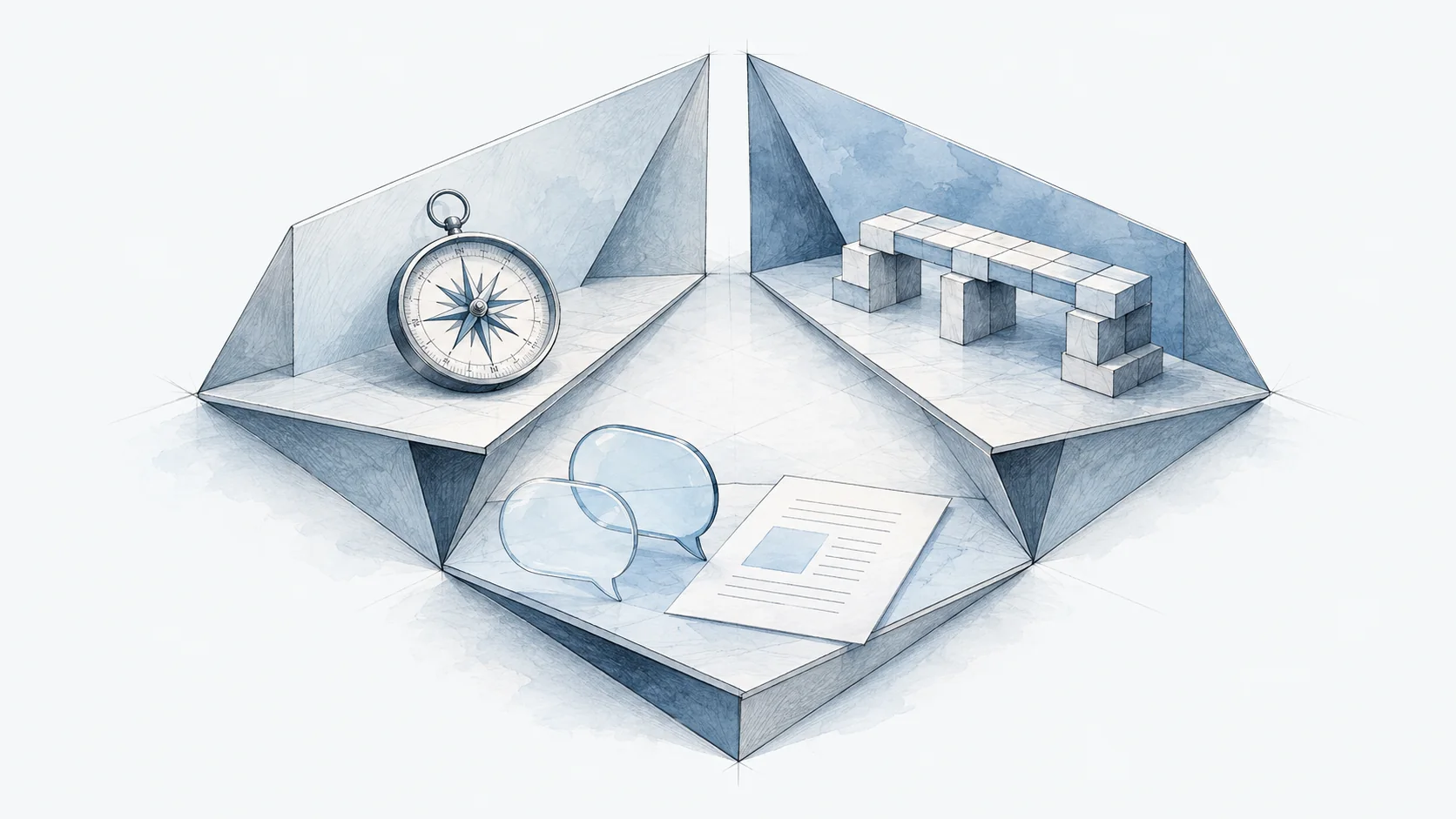
Align business goals, resources, and priorities.
Digital
Combine content, technology, and processes into a usable solution.
Creative
Make technical substance accessible through language, design, and user guidance.
A new tool, additional content or a campaign can be useful. However, it must first be clear what business change is to be achieved with it. We consider the initial situation from several perspectives: What do you already know? What feedback do customers and employees give? Which assumption is still uncertain? This leads to criteria for a decision.
Conscious renunciation is also part of making informed decisions. If a task incurs high coordination costs and its expected contribution remains unclear, a smaller test may be the better starting point. Smart therefore does not mean collecting as much data as possible. What matters is which information actually improves the next decision.
A website or an AI workflow must also be manageable after the initial publication. Therefore, responsibilities, access, maintenance, and handovers are part of the concept. What information does the solution need? Who confirms its correctness? What happens if a technical connection fails or a service changes?
The technical execution depends on the task and your available resources. A simple, well-maintained system can achieve more than a complex platform for which no one takes responsibility internally. During implementation, we therefore also consider later use. Files, content, and agreed-upon work steps should remain comprehensible to the responsible persons.
Creative connects understandable language, design, and creative problem-solving. A technical achievement can be described factually correctly and yet be difficult to classify. Then the connection to the interested party's question is often missing: What situation is this suitable for, what is the difference, and what do I need to know before making an inquiry?
We develop a suitable presentation for this. This could be a clearer page structure, a vivid example, an illustration, or another way to start a conversation. Design supports orientation. It does not replace a technical statement and does not need to draw attention to itself through additional effects.
For a B2B service page, the smart perspective clarifies the target audience and decision-making needs. Digital connects content, technical accessibility, and the path to inquiry. Creative makes differences and prerequisites understandable. If any of these contributions are missing, the solution remains incomplete: A beautiful page might miss the wrong questions; a technically correct page might be difficult to understand.
The method is therefore a common framework for work. You can start with a defined implementation if the basics are already clarified. If the direction is still open, a Discovery may be useful. The Overview of Work Formats explains how decision-making, visibility, and ongoing support differ.