In this post
An editorial plan does not yet answer questions about impact.
Content fulfills at least one specific task in a company's digital system: it provides orientation, builds justified trust, improves findability, or supports a decision and the next step.
An editorial plan organizes dates and formats. A content strategy, on the other hand, clarifies purpose, target audience, context, responsibility, and expected impact. Whoever reverses this order produces reliably, but not necessarily effectively.
Starting situation in August 2021
Many companies had expanded their digital communication in a short period of time. Newsletters were sent out more frequently, social networks were used more regularly, webinars were offered, and expert articles were planned. This increased visible activity. At the same time, the organizational pressure to constantly deliver new topics grew.
In practice, this often resulted in an editorial pattern:
- A separate plan was kept for each channel.
- Formats were selected according to publication rhythm.
- Topics were oriented towards trends, special days, or competitors.
- Success was primarily viewed in terms of reach and production volume.
- Older content remained without recognizable maintenance or linking logic.
The problem was not in the planning. The problem was that the planning started too early. Before it was clear what task content should fulfill in the information and decision-making process, the title, format, and deadline were already set.
What lies behind the problem
Production is easier to see than effect
A published page, a newsletter, or a social media post is a finished work result. Its impact is harder to assess. Orientation, trust, or better decisions do not always arise immediately and cannot be mapped with a single key figure.
This is why teams easily slip into a production logic. What can be counted becomes the control objective. Number of contributions, frequency, reach, or reactions then replace the professional question of whether the content has closed a relevant gap.
Channels set the pace
Platforms and editorial tools encourage regular publication. This creates the impression that every channel needs its own content continuously.
For companies, however, the starting point is not the provision of a channel. The starting point is a real information, trust, or decision-making task. Only then should it be examined which format and which channel can meaningfully support this task.
Topics are confused with user needs
A topic describes a subject. A user need describes what a person must understand, decide, or do in a specific situation.
"Digitalization", "sustainability", or "product innovation" can be relevant topic areas. They don't yet say what question a decision-maker has. Effective content translates the topic area into a precise task, for example:
- classify an unknown solution,
- compare two options,
- assess a risk,
- prepare an internal resolution,
- check the suitability of a provider,
- reliably execute a next step.
The user-oriented content design practice already clearly highlighted this connection. Content should not be created because an organization wants to say something, but because users need to know or do something.
Four tasks of content
1. Orientation
Orienting content helps a person understand a situation, a term, or a decision-making space.
It answers questions such as:
- What is it about?
- Which components belong together?
- What differences are relevant?
- What is one's own starting position?
- Which order makes sense?
Orientation is particularly important for services that require explanation. A service page can name an offer. A foundational article can explain the decision framework in which the offer makes sense or is unsuitable.
2. Trust
Trust is not built through frequent self-assertion. It is built when content makes competence understandable.
These include:
- clear and understandable statements,
- recognizable technical responsibility,
- Examples without artificial exaggeration,
- sources for verifiable claims,
- defined boundaries and conditions,
- Consistency with other statements of the company.
Trust-building content does not just show what a company offers. It shows how it thinks, tests, and decides.
3. Findability
Content can cover relevant questions and terms that people search for. However, findability is not an independent purpose if the found content does not provide a viable answer.
Search engine optimization and topic planning are therefore part of the content strategy, but not its substitute. The search query helps to recognize the need. The professional task determines what answer, depth, structure, and continuation are needed.
4. Decision and action
Content can prepare a decision or enable the next step.
To do this, it must do more than just attract attention. It should show:
- for whom a solution is suitable,
- what prerequisites must be met,
- what alternatives exist,
- what risks or limitations apply,
- what the next steps look like.
Not every post needs a direct sales call. A meaningful next step can also be a comparison, a deeper explanation, an internal review, or a suitable tool.
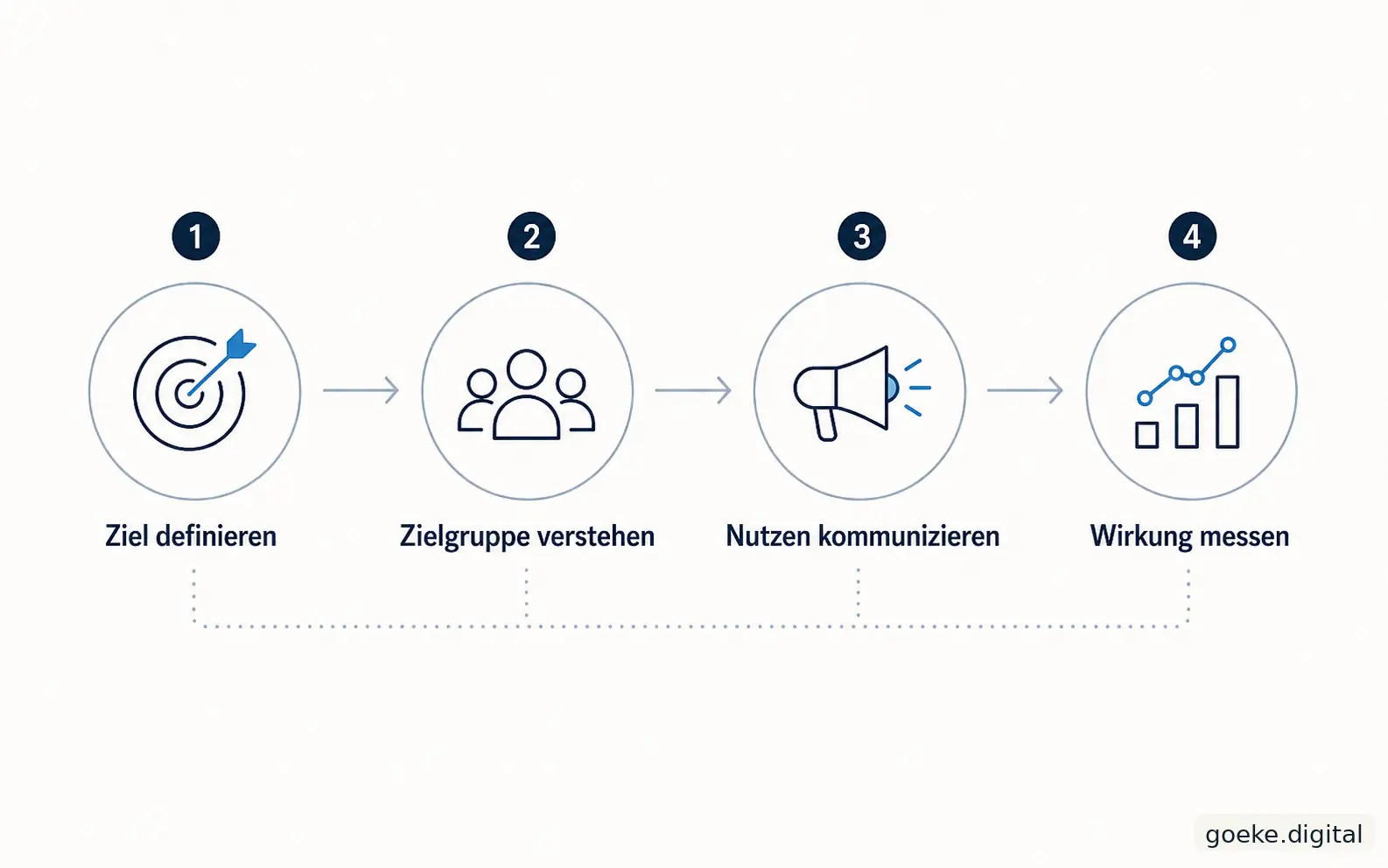
The impact model before the editorial plan
Six decisions should be made before any production.
1. Situation
In what specific situation is the reader?
"Managing Director" or "Head of Marketing" is not sufficient as a description. More relevant, for example: The website is to be rebuilt, but there is no internal agreement on target groups and page logic.
2. Task
What must the content achieve for this person?
The task can be to recognize a problem, differentiate options, examine risks, or prepare a decision.
3. Core message
What professional answer should be understandable after reading?
The core message must be sustainable even without a decorative introduction. It must not consist only of a general promise.
4. Voucher
What makes the statement understandable?
Depending on the content, these can be official sources, own documented data, methodological explanation, comprehensible experience, or a transparent example.
5. Connection
Which next content or action step is logical?
The connection arises from the task. It is not added retrospectively as an arbitrary call to action.
6. Maintenance
How long does the content remain valid and who checks it?
Even a timelessly designed contribution can contain outdated links, examples, or terms. Therefore, maintenance should already be part of the conception.
Channel metrics must not replace the task.
The primary task of a content and the key figure of a channel are not the same.
An expert article can provide orientation, even if it only triggers a few direct inquiries. A comparison page can prepare a decision, even if its reach remains limited. A short social media post can generate attention without carrying the expert reasoning itself.
Therefore, the effect should be considered as a chain:
- Is the content found or reached by the right person?
- Do they understand the central message?
- Does it use the content for context or decision-making?
- Does the content meaningfully lead to a next step?
- Does the message remain consistent over time and across channels?
Channel metrics remain useful. However, they only show a snapshot. If clicks, reach, or posting frequency become the sole control measure, production adapts to the channel and loses its business purpose.
Perspective from practice
In established corporate websites, there are often many technically correct contents. Nevertheless, they help neither users nor sales or search sufficiently.
Typical causes are:
- Several pages answer the same question differently.
- Technical articles have no relation to services or decision-making situations.
- Current contributions permanently displace important fundamentals.
- Content ends without meaningful continuation.
- Those responsible cannot say what task a contribution fulfills.
- Editorial plans create new files, but not better structure.
The most effective correction is often not a new list of topics. First, existing content is organized according to its task. Some contributions are merged, others newly linked, some updated, and others removed. Only the identified gaps are newly produced.
Framework of action
1. Every piece of content receives a statement of effect
The impact statement describes in one sentence who the content helps, in which situation, and with what.
Example:
This post helps management recognize, before a website relaunch, which strategic decisions must be made before design and technology.
Such a sentence is more precise than 'The contribution should demonstrate our expertise'.
2. A piece of content is assigned a primary task
A contribution can support multiple effects. However, for conception and testing, it still needs a primary task.
Anyone who wants to maximize attention, search ranking, lead generation, training, customer service, and brand building at the same time usually creates overloaded content.
3. Editorial planning follows the gap analysis
The editorial plan is only created once it is known:
- what user questions have already been answered,
- which content overlaps,
- where evidence is missing,
- which topics are relevant to the business,
- what content needs to be updated or merged.
4. Channels use shared knowledge building blocks
A technical article, sales documentation, and a newsletter can be based on the same technical foundation. However, they require different selection, depth, and form.
The goal is not to play out the same text everywhere. The goal is a consistent core message that is translated for the respective usage context.
5. Assess success by task
An orienting foundational article is evaluated differently than a landing page or a newsletter.
Possible test questions are:
- Is the central question actually answered?
- Do users find suitable in-depth information?
- Are frequent misunderstandings reduced?
- Does the content support more qualified conversations?
- Does the statement remain consistent across multiple channels?
- Is the maintenance effort justifiable?
What companies should not do
Companies should not confuse the editorial plan with the strategy.
Not sensible are:
- Frequency goals without subject matter priority,
- Topic production only from keyword lists,
- identical content for all channels,
- artificial timeliness for timeless questions,
- Publications without a responsible owner,
- blanket calls to action without a logical connection,
- new posts, even though existing content is disorganized or contradictory.
A smaller number of clear, connected, and maintained content pieces can achieve more than a high production frequency.
Consequences for companies
Content should be planned as a functional component of the digital system. The editorial plan remains important, but it comes at the end of a sequence of professional decisions.
The central question is not: "What will we publish next month?"
It reads: “What relevant orientation, evidence, or decision-making aid is currently missing and how will it be integrated into the existing system?”
On this basis, content becomes plannable, verifiable, and usable in the long term.
Subject-matter connection
Content strategy as an architecture of effect and topics
A content strategy organizes existing content, relevant questions, subject matter evidence, and business connections into a robust system. Within the scope of SDC-Growth, this structure can be built, reviewed, and further developed step by step without making content production an end in itself.
Systematically develop content and visibility within the scope of SDC Growth
Sources and technical foundations (4)
- Government Digital Service, Some interesting things about how we do content design, June 13, 2014. Open source
- Government Digital Service, Learning about users and their needs, April 4, 2016. Open source
- W3C Web Accessibility Initiative, Making Content Usable for People with Cognitive and Learning Disabilities, April 29, 2021. Open source
- W3C Web Accessibility Initiative, Headings. Open source