
In this post
Reach does not make an unclear statement more relevant
Positioning arises from strategic selection: for whom a service is relevant in which situation, against which alternatives it is classified, and which verifiable difference carries the decision.
Channels distribute this meaning. If it is unclear, they primarily distribute different descriptions, changing focuses, and generic service promises.
Starting point
In 2021, many companies expanded their digital communication in a short time. In addition to the website, newsletters, social networks, webinars, digital presentations, and new campaign formats became more important. The obvious expectation was: those who are visible in more places will be perceived more clearly and considered more often.
In practice, the opposite often occurred. The website described the company as a comprehensive partner. A social channel highlighted individual services. Sales documents emphasized experience. Campaigns worked with short-term problems. On another sub-page, innovation became the main argument.
Each statement could be plausible on its own. However, together they did not form a clear picture. Interested parties saw more content, but not necessarily clearer what the company should stand for in the relevant comparison.
The problem was not a lack of a channel. It was an unclear selection before communication.
What lies behind the problem
Channels are confused with strategy
A channel answers where and in what format a statement appears. Positioning answers what meaning a company should take on for a specific target group and decision-making situation.
These levels are easily mixed up. A new LinkedIn presence, a newsletter, or a webinar program seems like strategic progress because something visible is created. The more difficult decisions often remain open:
- Which customer and problem situation should be the focus?
- Against which real alternatives is the offer compared?
- Which characteristic is actually relevant for this decision?
- How can this characteristic be proven?
- Which services or target groups are consciously not made a focus?
Without this selection, activity arises, but not a robust position.
Companies describe themselves from the inside view
Many service descriptions follow their own organization. They name departments, competencies, technologies, or product groups. However, decision-makers assess offers based on their situation. They do not compare the internal completeness of a provider, but its suitability for a specific problem.
Therefore, positioning does not simply translate the entire company into communication. It selects the relevant excerpt and places it within an understandable frame of reference.
April Dunford's 2019 positioning approach focuses precisely on this context: alternatives, unique characteristics, resulting value, suitable target customers, and the appropriate market category must align. The practical consequence is sober. A service can be good and still be classified incorrectly or too generally.
More content generates more variants
If the strategic foundation is missing, channels develop their own narratives. An external service provider formulates differently than the sales team. Specialist departments set different priorities than management. Campaigns react to short-term search terms, while the website clings to older messages.
The number of variants grows faster than clarity. The effort for coordination increases. At the same time, it becomes more difficult to learn from reactions because it remains unclear which statement was actually tested.
General quality promises do not differentiate
Terms such as quality, reliability, innovation, customer proximity, or customized solutions are not fundamentally wrong. However, they only become effective when they are specified and substantiated.
A decision-maker can hardly weigh a general quality promise against other providers. They need a comprehensible connection: What form of quality is crucial in their situation? How is it visible? Which alternative becomes less suitable as a result?
Positioning therefore does not necessarily require spectacular uniqueness. It requires relevant and credible differentiation.
Strategic Classification
Positioning is a decision about meaning
Kevin Lane Keller describes brand positioning as part of strategic brand management. At its core, it's about relevant, advantageous, and distinct associations in the target audience's memory. These associations are not created by a single formulation. They are built through repeated, consistent experiences and communication.
For companies, this means: Positioning is not a project for the text department. It connects market decisions, performance logic, sales, communication, and record-keeping.
A viable positioning answers five questions:
- For whom? Which target group has the appropriate starting position and decision-making power?
- In which situation? What problem, goal, or event makes the service relevant?
- Compared to what? What alternatives does the decision-maker actually consider?
- Why this solution? Which difference is significant for this situation?
- What makes it credible? What experience, method, structure, or source supports the statement?
Only then can it be meaningfully decided which channel takes on which task.
Reach reinforces what already exists
A clearly positioned company can use different channels in different ways without diluting its meaning. The website explains the connection. Technical articles delve into individual questions. Sales documents translate the position into concrete decision criteria. A webinar demonstrates the workflow. The formats differ, but they all contribute to the same positioning.
With unclear positioning, reach acts like an amplifier without a clean signal. More people see more variants. The company may become better known, but not necessarily better understood.
Trust requires consistency
The 2021 Edelman Trust Barometer Special Report highlighted trust as an essential component of brand relationships. This does not provide a simple formula for strategic communication. However, it shows that a brand's impact does not depend solely on recognition.
Trust is built more easily when statements, behavior, and experiences align. Contradictory positioning makes this expectation formation more difficult. Anyone who promises a different focus on every channel forces the interested party to reconstruct it themselves.
Perspective from practice
A positioning problem often only becomes apparent when a website is revised or a new campaign is planned. Then several versions of texts, offer descriptions, and target group definitions lie next to each other. Each department can justify why its focus is important.
The crucial work is not to integrate all statements into a longer text. It consists of taking responsibility for an order.
In practice, a simple separation helps:
- What is true in the company?
- What of this is relevant to the selected target group?
- What distinguishes performance in real comparison?
- What can be demonstrably proven?
- Which statement must remain stable at every touchpoint?
This does not make positioning smaller, but more precise. The company can continue to offer multiple services. It just no longer tries to make them all the main message at the same time.
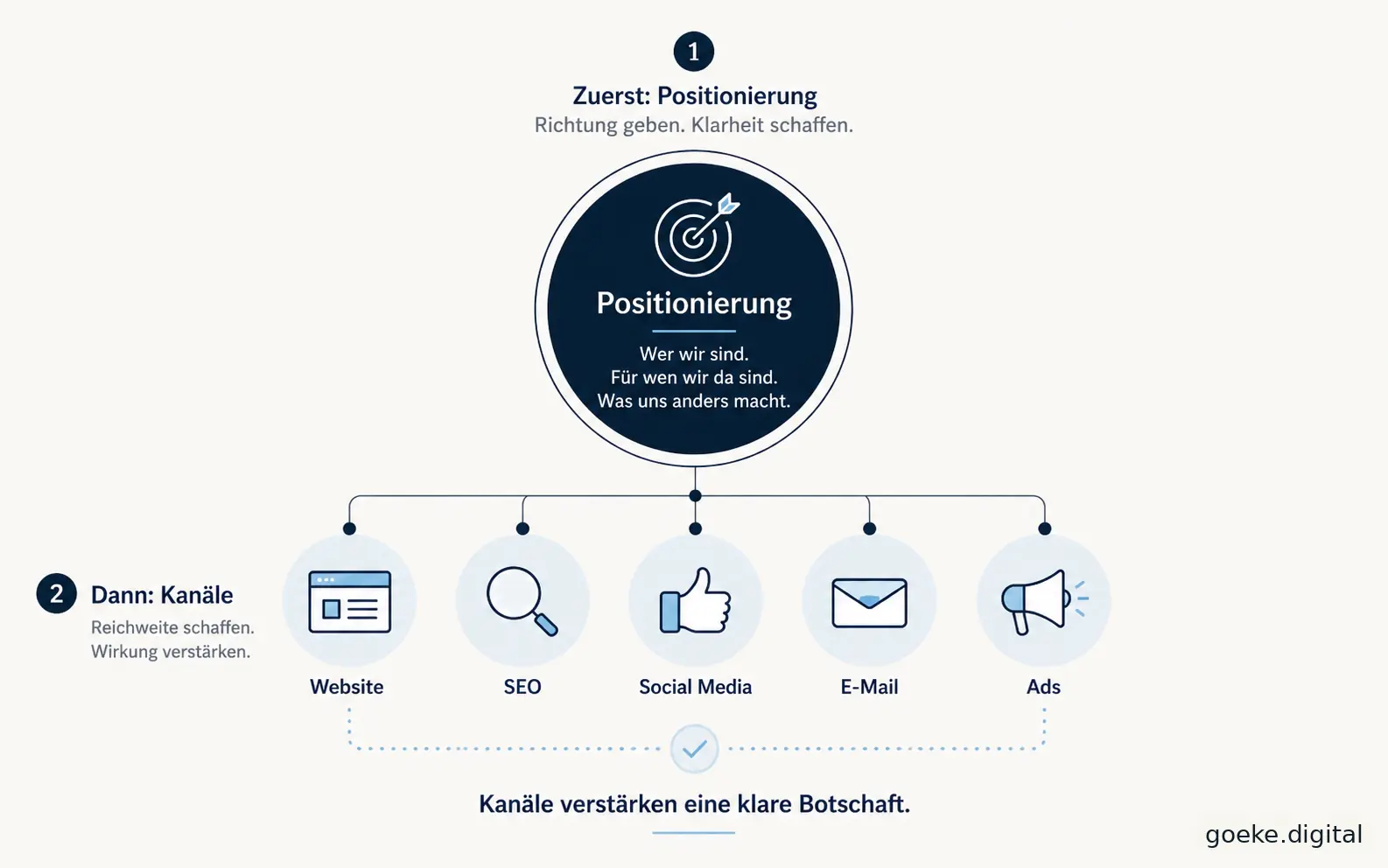
The positioning and effect chain
The chain makes an important dependency visible. A channel is not the beginning of the effect. It is a handover point. Before it, meaning and proof must be clarified. After it, the recipient's perception decides whether orientation and trust are created.
Framework of action
1. Clarify the real comparison space
Companies should not just list competitors. Crucial are all alternatives from which a customer can actually choose. These include internal solutions, existing service providers, standard software, postponement, or foregoing an action.
2. Select relevant differences
Not every special feature is decision-relevant. A difference should solve a concrete problem better, reduce a risk, simplify a decision, or make an economic contribution understandable.
3. Gather evidence before formulating
Experience, processes, specialization, data, technical skills, or demonstrable applications give substance to the position. If proof is lacking, the statement should be formulated more cautiously or not made the main argument.
4. Define a stable core message
The core message does not have to appear word-for-word on every channel. However, its meaning must not change. Target group, problem context, difference, and benefit must remain recognizably linked.
Give 5 channels clear tasks
Only after the positioning decision is made, it is determined which function website, specialist articles, newsletters, events, or social networks will take over. One channel explains, another deepens, a third activates. None invents its own position.
What companies should not do
Companies should not respond to a positioning problem with a higher publication frequency. More contributions, ads, or platforms increase coordination effort if the central message remains unclear.
Likewise, a new slogan is of little help if the target group, frame of reference, and evidence remain indistinct. Linguistic conciseness can make a strategic decision visible. It cannot replace it.
The complete adaptation to every channel is also problematic. A B2B brand does not have to become a different organization on LinkedIn than on its website. Form and depth may vary. The underlying meaning must remain recognizable.
Consequences for companies
Before expanding digital reach, it should be clarified which signal is to be amplified in the first place.
A robust positioning does not reduce a company's diversity. It creates an understandable order. This makes websites, sales, content, and campaigns coherent. Decisions about channels can then be derived from their purpose, rather than from general visibility pressure.
The related article "More digital measures do not create a digital strategy" transfers the same basic logic to the overall digital system. The number of measures is not a reliable indicator of maturity in either strategy or positioning.
Subject-matter connection
Clarify positioning before expanding communication
A positioning strategy examines the target group, decision situation, comparison alternatives, relevant differences, evidence, and the subsequent translation into website, content, and sales. It creates the foundation before additional channels or campaigns are developed.
Clarify positioning strategy systematically
Sources and technical foundations (3)
- April Dunford, Obviously Awesome: How to Nail Product Positioning so Customers Get It, Buy It, Love It, Ambient Press, 2019. Open source
- Kevin Lane Keller and Vanitha Swaminathan, Strategic Brand Management: Building, Measuring, and Managing Brand Equity, 5th Edition, Pearson, 2020. Open source
- Edelman, 2021 Trust Barometer Special Report: Trust, The New Brand Equity, 2021. Open source