In this post
Digital impact arises from resilient connections
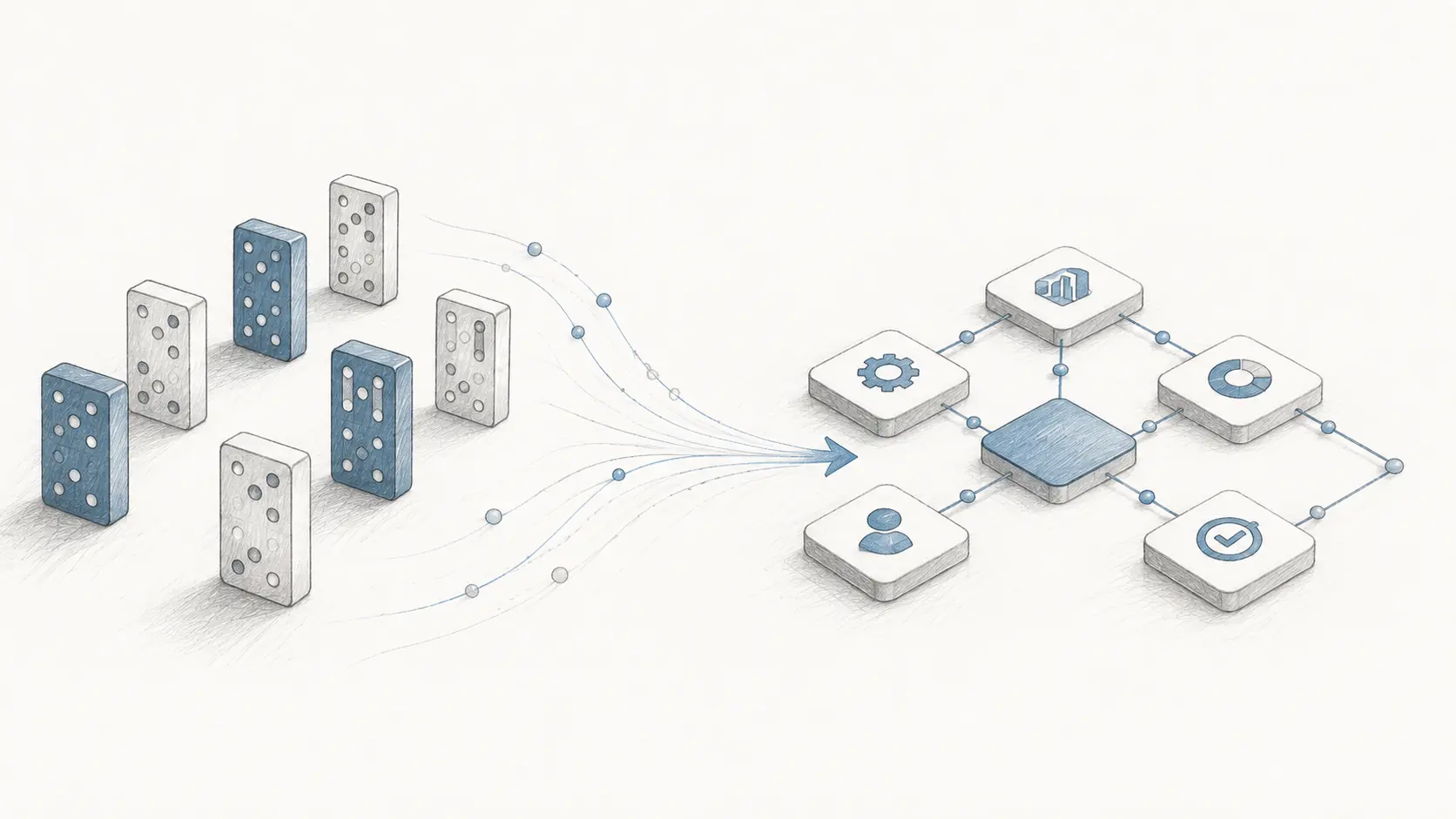
A digital impact system is the ordered connection of strategic decisions, clear positioning, usable company knowledge, digital access, technical systems, organizational responsibility, and continuous control.
It is neither a single platform nor a rigid model. It describes how a company aligns digital capabilities so that actions make a common business contribution, remain manageable in operation, and can be learned from results.
Starting point
Established companies rarely have too little digital activity. They have websites, campaigns, newsletters, social channels, analytics tools, CRM systems, automation, external partners, and initial AI applications. Many of these elements fulfill their immediate purpose.
Nevertheless, the overall effect often remains below its potential. Content explains other priorities than sales. Campaigns lead to pages that are not prepared for the respective decision. Data resides in multiple systems. Responsibilities end upon project completion. AI applications access knowledge whose validity has not been definitively verified by anyone.
The problem then lies not in the quality of each individual measure. It lies in the missing connections between them.
An impact system makes these connections the subject of strategy. It asks not only whether a channel works, but whether the entire sequence of business goal, message, content, access, interaction, data, responsibility, and improvement fits together.
What lies behind the problem
Local successes can weaken the overall impact
A department can improve its key figure and create friction elsewhere at the same time. More reach can increase unsuitable requests. Faster content production can multiply contradictory statements. New automation can save time and create additional data copies simultaneously.
Such effects arise when decisions are evaluated only within a single measure. An impact system therefore does not consider the immediate output alone. It examines the contribution to the overarching goal and the consequences for adjacent processes.
Projects have an end, digital impact does not
A relaunch, a campaign, or an integration can be completed. However, the digital capability created by it remains in operation. Content must be maintained, systems updated, results evaluated, and responsibilities retained.
Those who organize digital development exclusively as a consequence of individual projects repeatedly build new solutions without sufficiently anchoring their permanent operation. The early core contribution "Digital presence is not a finished project" describes this basic logic.
Dependencies remain between areas of responsibility
Positioning is treated as a communication topic, data as a technology topic, content as a marketing task, and processes as an organizational topic. In practice, these areas overlap.
A website can only convey an offering clearly if positioning and target group decisions are robust. An AI application can only reliably support content if knowledge, sources, and verification rules are clarified. Reporting can only control if it has been decided beforehand which impact is to be measured.
The crucial problems therefore often lie at the transitions. It is precisely there that responsibilities are least clear.
New AI and response systems increase the need for order
Generative search, AI assistants, and automated workflows access existing content, data, and processes. They do not automatically reduce existing ambiguities. They can spread them faster.
Google continues to describe the importance of helpful, original content, clear technical structures, and accessible pages for its generative search features. The NIST AI Risk Management Framework presents governance, context, measurement, and risk management as interconnected tasks. Both perspectives lead to the same strategic consequence: new digital capabilities require a robust foundation and ongoing accountability.
Strategic Classification
What a digital impact system is
A digital impact system connects seven levels:
-
Strategic direction
The company clarifies which business change is to be digitally supported, which target groups and situations are relevant, and what is deliberately omitted. -
Positioning and Relevance
Offers, benefits, differences, and evidence are clarified in such a way that people and systems can understand what the company offers a credible answer for. -
Knowledge and content
Expert knowledge is not just published, but structured, substantiated, maintained, and made usable for recurring communication and decision-making tasks. -
Visibility and Access
Relevant information is discoverable and accessible via website, search, response systems, platforms, direct communication, and other contact points. -
Technology and Data
Systems fulfill clear tasks, exchange necessary data in a controlled manner, and remain manageable in terms of operation, security, costs, and interchangeability. -
Processes and responsibility
Decisions, creation, review, approval, operation, and escalation have traceable roles and repeatable processes. -
Measurement and learning
The company connects quantitative data, qualitative feedback, and regular decisions into a learning loop.
These levels do not form a linear production line. They influence each other. New insights from sales or usage can sharpen positioning. Technical limitations may require different process design. A knowledge gap can reveal that an offer is not sufficiently clarified in terms of content.
What a digital impact system is not
An impact system is not a central software where all tasks are brought together. A company can operate a resilient impact system with several specialized tools, provided that tasks, data, and responsibility are clear.
It is also not a complete degree of automation. Some decisions and interactions consciously remain human. Automation is useful when the task, quality limit, and control are clarified.
Likewise, the system is not a once-designed ideal state. It must remain changeable. Strategy provides direction, but the roadmap, processes, and technologies will be adapted to new insights.
Finally, an impact system is not a pretext for comprehensive centralization. Departments need scope for action. The common order focuses on goals, binding terms, interfaces, leading data, responsibilities, and decisions with company-wide impact.
How the levels interact
Direction without relevance remains abstract
A strategic goal such as 'increase digital visibility' is too general. It only becomes actionable when it is clear for which target groups, questions, and business situations the company should be visible and relevant.
Positioning translates direction into an understandable choice. It not only determines a message but influences topics, evidence, side roles, campaigns, and sales arguments.
Relevance without knowledge remains assertion
A promise of performance requires substance. Companies must be able to explain how they work, what conditions apply, what limits exist, and what their statements are based on.
This substance must not reside solely in individual minds or project files. It must be available in a form that can be consistently used by marketing, sales, service, the website, and controlled AI processes.
Knowledge without access remains invisible
A good internal document does not automatically create digital impact. Knowledge must be translated into suitable content formats, pages, and interactions. It requires a comprehensible architecture, clear authorship, and technical accessibility.
Visibility here means more than just placement. The crucial factor is whether a relevant person or a mediating system can find the right message in the appropriate context and attribute it to the company.
Access without viable systems remains unstable
Visible digital services require a robust technical foundation. This includes not only availability and loading time. Equally important are data flows, rights, integrations, maintainability, security, portability, and the management of dependencies.
The smallest viable system landscape is often more effective than a large collection of partially used tools. The contribution „Fewer tools, clearer systems, better decisions“ classifies this architectural decision.
Systems without responsibility create new dependencies
Technology can support processes. However, it does not automatically assume responsibility for data quality, approvals, error handling, and further development.
Every digitally important business capability needs an owner. This role does not have to perform every task itself. However, it must coordinate decisions, ensure quality, and be capable of action in the event of conflicting goals.
Responsibility without measurement preserves assumptions
Clear responsibility alone does not prove effectiveness. Companies need measurement points that match the effectiveness goal. These can include reach, qualified inquiries, usage, completion rate, processing time, errors, follow-up questions, or qualitative feedback.
The number of key figures is not decisive. The agreed-upon reaction is decisive. A key figure only becomes relevant for control when it is clear what question it answers and who derives a decision from its change.
Measurement without learning becomes reporting
Reports can be extensive and still not trigger development. A learning loop connects observation, interpretation, decision, implementation, and re-examination.
Official service and quality guidelines therefore treat continuous improvement as part of operations. Digital impact is not achieved through a perfect initial state, but through a reliable ability to correct.
Perspective from practice
For the inventory, it is helpful to distinguish four types of problems:
Measure problem
A specific measure is technically weak or does not achieve its immediate goal. Example: A landing page explains the offer unclearly, or a form does not function reliably.
A measure problem can be solved locally. It does not automatically justify a new overall strategy.
Structural problem
A recurring task has no clear role, no process, or no quality control. For example, content is created but not professionally approved and later not updated.
Improving a single result is not enough here. A repeatable structure is needed.
System problem
Several areas, tools, or data flows do not meaningfully integrate with one another. The website uses different performance terms than the products and sales. Contact data is maintained multiple times. Campaigns, content, and measurement follow different target visions.
A system problem requires clarification of connections and leading sources.
Control problem
Goals, priorities, responsibilities, and checkpoints are not definitively decided. The company starts many projects but cannot resolve conflicting goals.
A control problem lies at the management level. It cannot be permanently compensated for by better operational implementation.
This distinction protects against overreactions. Not every problem requires a comprehensive transformation program. Conversely, a system or control problem should not be treated as a minor optimization task.
Framework of action
1. Define the business impact goal
Formulate the change that is to be digitally supported. A good impact goal describes not just an activity, but the desired contribution for customers, sales, operations, or market position.
2. Capture existing elements and breaks
Document positioning, core messaging, content, channels, systems, data sources, processes, owners, and measurement points. Highlight contradictions, redundancies, missing handoffs, and key person dependencies.
3. Correctly classify the problem
Determine whether the essential obstacles lie at the measure, structure, system, or management level. Multiple levels can be affected simultaneously. The highest affected level often determines the necessary intervention.
4. Define binding foundations
Clarify central terms, leading knowledge and data sources, system roles, decision-making rights, and quality requirements. These foundations do not need to be complete. They must be sufficient for the prioritized tasks.
5. Build a dependency logic
Assign which prerequisites must be created before which visible measures. The roadmap connects goals, milestones, resources, responsibilities, and decision points from this. "What a robust digital roadmap must achieve" describes this planning level in detail.
6. Anchor operation and improvement from the start
Determine during the conception phase who will operate content, systems, data, and processes after implementation. Define review intervals, escalation paths, and criteria for adaptation or decommissioning.
7. Review impact together
Combine a few quantitative metrics with qualitative observations from customer contact, sales, support, and specialist departments. Evaluate not only individual channels but the chain of effects from need to business result.
What companies should not do
Companies should not set up an impact system as a major additional project alongside ongoing operations. The task is precisely to organize existing elements, not to create another parallel structure.
Nor should you try to perfect all seven layers at once. The inventory serves to identify the crucial bottleneck and its dependencies. That is where the work begins.
A pure centralization logic is equally unsuitable. Not all knowledge, decisions, and tools need to be in one place. Only those fundamentals whose contradiction weakens the overall effect need to be clarified centrally.
Finally, the model should not be used as a linguistic label for unchanged individual measures. An effectiveness system is demonstrated through common goals, binding handovers, clear responsibilities, and a visible learning loop.
Consequences for companies
The transition from individual measures to a digital impact system changes the type of control.
Management no longer decides solely on budgets and projects, but on impact goals, priorities, and conflicting objectives. Marketing is responsible not only for publications, but for the usability and consistency of relevant knowledge. IT and external partners are involved not only in implementation, but in architecture, data, operations, and risks. Departments not only provide content occasionally, but take on defined roles in review and updating.
This does not make individual measures disappear. Websites, content, search, campaigns, automation, and AI remain concrete fields of work. However, they receive a common frame of reference.
A robust digital impact system has three recognizable properties:
- Relevance: Measures serve a clarified business and customer-related task.
- Controllability: Systems, data, processes, and responsibility can be reliably operated and changed.
- Learning ability: Results lead to understandable decisions and improvements.
The current prioritization addresses „Digital Impact 2026: What companies must prioritize now“. The permanent operational logic begins with "Digital presence is not a finished project". The complete overview is provided by the Subject Areas Digital Strategy.
Subject-matter connection
Manage digital development as a coherent impact system
The SDC Partnership creates a common strategic and operational level for companies whose digital measures, systems, and responsibilities already depend on each other. It connects inventory, prioritization, knowledge and system architecture, implementation, quality assurance, and ongoing management without replacing the company's professional responsibility.
Connect digital individual measures to a controllable system of effects
Sources and technical foundations (10)
- Michael E. Porter, “What Is Strategy?”, Harvard Business Review, 1996. Open source
- Institute for Strategy and Competitiveness, Harvard Business School, “Strategy Explained”. Open source
- GOV.UK Service Manual, „Iterate and improve frequently“. Open source
- GOV.UK Service Manual, „Managing and improving your service through its lifecycle“. Open source
- ISO, „Quality management principles“. Open source
- NIST, „Artificial Intelligence Risk Management Framework“. Open source
- NIST, “Cybersecurity Framework 2.0”. Open source
- Google Search Central, „Optimizing your website for generative AI features on Google Search“, as of July 2026. Open source
- European Commission, “2026 State of the Digital Decade package”, 2026. Open source
- European Commission, "AI Act. Regulatory framework and application timeline". Open source